Monday, 15 July 2019

RESEARCH Bauer Media


BAUER MEDIA


What is Bauer media?

Bauer Media UK is an entertainment network of iconic, multi-platform brands.

The business became part of the Bauer Media Group, Europe’s largest privately-owned media group, in 2008. Founded in Hamburg in 1875 and now in its fifth generation of family ownership, the Bauer Media Group operates in 20 countries including the UK, Germany, Poland, Australia, New Zealand and the USA and has 11,000 employees worldwide.


When was Bauer Media established?

1875


  • Heinz Bauer, 72, is the chairman of the German media giant, which dates back to 1875. Forbes estimates his wealth at $1.8bn (£1.1bn). But the father of four is taking an increasingly backseat role, letting his daughter Yvonne, aged around 36, take over as chief executive. She is said to have majority control.
  • The Bauers are keen on keeping their lives private, in contrast with some of their magazines, which love tittle-tattle. (The French edition of Closer, which published those topless pictures of the Duchess of Cambridge, is published separately by Italy's Mondadori under licence from Bauer.)

"They're passionate about print and radio. Their primary focus is how good is the product. They are regularly in the UK. We visited every single one of our 20-plus radio station in the UK with Heinz and Saskia in the last year."


  • A flurry of recent activity suggests that Yvonne Bauer has ambitions to expand this global empire, which already extends to 15 countries.
  • Here in Britain, Bauer tried to buy GMG Radio, the owner of Smooth and Real Radio, but lost out to rival Global Radio, which paid £70m in July. If Bauer had succeeded, it would control close to a third of commercial radio in Britain.
  • While radio is doing well, some analysts wonder about Bauer's strategy for its magazines, which have seen revenues come under pressure.
    What are some of the brands they own?
    In the UK we reach 25 million consumers. Our portfolio includes heat, KISS, Grazia, Empire, Motor Cycle News, Parkers, TV Choice, Take a Break, Bella, Magic and Absolute Radio. Our scale, coupled with the breadth of our portfolio, gives us an advantage over pure play magazine or radio competitors.


How did they respond to a decline in magazine sales?

Print magazines were the worst hit, with bookings falling 42.5%. Magazines’ digital properties also suffered a 40.5% decline, compared to January 2017. Newspapers didn’t fare much better, falling 36.4% in print and 27.6% in digital.

Bauer Media too recognised it needed to improve its relationship with agencies.

Paul Gardiner, Bauer Media sales director, said:” We don’t believe that these figures represent an accurate overall snapshot of our business. Our direct revenues continue to grow and magazine readership is actually increasing over the summer period.

“We recognised there is a problem with agency revenue and have been working closely with our partners to turn this around. We have updated our agency structure in December to ensure that service levels remain high, and we have also recently launched our Story54 brand entertainment division to deliver better customer solutions.

“Bauer Media has strong forward bookings and a robust growth strategy for 2018 and beyond.  Our clients will be seeing a very different proposition for our magazine brands over the coming months “

The closure of the Australian Cosmopolitan

The company has issued a statement from Bauer Media ANZ CEO Paul Dykzeul: "Today, Bauer Media announced the closure of the Cosmopolitan brand in Australia, with the December issue being the last. It has not been an easy decision to make, however, the commercial viability of the magazine in Australia is no longer sustainable."

The closure follows the merging of the print and digital teams at Elle and Harper's Bazaar in September, along with 13 roles that were axed as part of the restructure.

Bauer has also made several major changes in a bid to position itself as the leading Australian publisher of homes and lifestyle content, making several major moves within the past year, including its acquisition of Inside Out, Country Style and HomeLife.com.au. From News Corp.

“Magazine closures are never easy, desirable or done without careful consideration for all of those involved" adds Dykzeul. "We have to ensure that we are continually reshaping and defining the business so that our readers of today, and those of tomorrow, remain engaged with the content we publish and the platforms upon which we deliver.


Case studies

The challenge currys PC world

Our goal was to stimulate growth of Currys PC World’s core range of laptops, specifically the HP Pavilion and software bundles.

We needed to offer flexibility in messaging as there are two distinct demographics (45+ and 16-34s), and also demonstrate that Currys PC World’s can facilitate passions and ambitions ‘we help you get it right’.

The insight

There are more similarities between a 25 year old and a 45 year old than you first might think.

The millennial audience want it all and are not afraid to put themselves out there, they know what they want to be and by when. The mid-life crisis is real with many adults changing jobs, learning new skills or passions at this key time.

Both demographics want to live life to the full so this campaign idea would need to inspire them to do so.

The idea

A content-led idea that uses talent from each Bauer brand to ’Ignite Your Passion’ on a new adventure – focusing on individual passions and ambitions of the talent and the audience that will place the HP Pavillion 14 and software bundles at the heart.

The execution


Results

48% of the audience took some kind of action

16% of the exposed audience purchased something in store or online

The challenge- River Island


River Island were looking for a partnership for AW17 that would help improve their credibility as a fashion authority while empowering an 18-30 audience to express their own style.  They wanted to encourage conversation and expression of identity in the context of not just fashion, but in areas such as confidence and opinion.

The Insight
What a woman looks like says a lot of about who she is and what she stands for.  Her identity is not just about the jeans she wears or indeed how she wears them but about inner confidence, empowerment, knowing who she is and what she thinks. This millennial female insight led to the campaign idea.
The Idea
A six-part, cross-platform artist and fashion franchise, the series I AM shone a spotlight on six of the UK’s hottest emerging artists including Anne-Marie, Ella Eyre & Tom Grennan; exploring the relationship between their music and notions of identity and style. We then took those styles and revealed to audiences how to get that look and trend, influenced by the artists and dressed by River Island.
The series ran across three Bauer brands and leveraged Bauer talent from across the business.
Execution

 Results
Won silver at the Branded Film Festival 2018
1.12M TV Reach
6.5M Social Media Reach


Monday, 8 July 2019

AUDIENCE RESEARCH Feedback from pitch


I found the task of the pitch very helpful because it helped me to understand the faults with my idea. This was reinforced by the feedback I was given, reiterating that my idea maybe wasn't 'fun-loving' enough. Afterwards it made me rethink my idea and also reconsider any other briefs that I woulds enjoy more. 


Sunday, 7 July 2019

RESEARCH The history of television

Of every entertainment platform there is, perhaps none has changed so much, and so quickly, than television. In just the past few years alone, the medium has gone from being labeled a silly, inferior substitute to movies to being hailed as the replacement for film, due to the rise in high-quality cable shows like Game of Thrones and Breaking Bad. Some are calling it the second Golden Age of TV, while others are dismissing it as just yet another trend that's bound to pass. Yet, whatever you think, there's no doubt about it: television has undergone a major revitalization, and, considering how many new shows are being made each year, it's unlikely to stop changing anytime soon.
Which begs the question: what will TV be like down the line? Think about how much the platform has changed just since 2010; in another five years, in 2020, TV could look much, much different than how we know it today — especially in the drama side, where the biggest transformation has occurred. And, while no one knows exactly what that change will be, of course, I've done enough research into the television patterns of the last several decades to make some predictions.
Below, here's what TV dramas of the past three and a half decades have looked like, and what they might just look like in 2020:

1980s


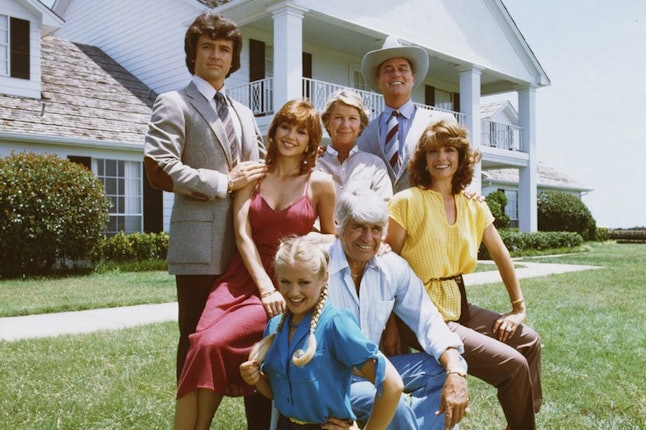
Top 10 Dramas: Dallas (above); Murder, She Wrote; Dynasty; Magnum, P.I.; Falcon Crest; Simon & Simon; Knots Landing; Matlock; L.A Law; Hotel
General Themes: The family soap opera (scandals! affairs! murder!) started with Dallas and influenced Dynasty, Falcon Crest, and Knots Landing. There was also a lot of love for the "lovable individual solving mysteries" storyline, as well as a focus on the workings of the law.
Cast Type: Ensemble was in, with shows from Dynasty to L.A. Law using the setup to tell a whole bunch of stories at once.
Female Presence: Murder, She Wrote and Falcon Crest were the only two in the top ten to truly have female leads, although several of the ensemble shows included women in the cast. Magnum P.I, Simon & Simon, and Matlock didn't fare as well, with the Tom Selleck series basically being an advertisement for masculinity.
Diversity Check: '80s drama typically went by the "star white people, but throw a token black guy into the cast" rule. L.A. Law did the best of the bunch, but not by much.
Relationship Statuses: The "happily single and/or in a healthy relationship" idea didn't seem to go over well with '80s TV creators, as nearly every protagonist from these ten series was divorced, widowed, or married but having tons of affairs. Except for Magnum, of course, who enjoyed plenty of flings with the women of Hawaii.

Tuesday, 25 June 2019

GENERIC RESEARCH Industrial context

Contemporary Context


  1. Who are the major players in this industry?

Ed Sheeran- His music video 'Shape of you' has over 4.2 Billion views. 
On 30 January 2017, the song's official music video, starring American dancer and model Jennie Pegouskie and retired professional sumo wrestler Yamamotoyama Ryuta (credited as "Yama"), was released on Sheeran's channel. It was shot on location in Seattle, and was directed by Jason Koenig. On 8 May 2017, 97 days after its release, it became one of the fastest music videos to reach 1 billion views on YouTube, and as of May 2019, the music video has over 4.2 billion views on the site and is the sites second most watched video.
Some of his other popular videos include 'Thinking out loud' 2.7 billion views and 'Perfect' 2 billion views. 
His demographic is 15-25 mass market which is very similar to the brief. 

Drake- hotline bling 1.5 billion views 

Drake announced a music video for the track via his Instagram account. The video was financed by Apple inc. and released on October 19, 2015 via Apple Music under a timed exclusivity agreement.The Director X-directed video was inspired by the work of American artist James Turrell. X has stated that he hopes that the video inspires men to dance more.


Rap-up wrote that Drake "shows just how suave he can be with his moves" in this video. Evan Minsker of Pitchfork called it a "pretty minimal clip". The site also named "Hotline Bling" the seventh best music video of 2015.


God's plan 1 billion views
It won numerous awards for the artist including: BET Awards video of the year, Hip hop. de awards  best song international as well as iHeartradio best director

The demographic for Drake is 15-21 rap and hip hop fans

GENERIC RESEARCH Industrial Context

Brief history/timeline of music videos

1894 - The first step towards the creation of music videos
Sheet music publishers Edward B. Marks Joe Stern hired electrician George Thomas and various performers to promote sales of their song "The Little Lost Child". Using a magic lantern, Thomas projected a series of still images on a screen simultaneous to live performances. This would become a popular form of entertainment known as the illustrated song, the first step toward music video.

1920's - With the arrival of "talkies" many musical short films were produced. Vitaphone shorts (produced by Warner Bros.) featured many bands, vocalists and dancers. Animation artist Max Fleischer introduced a series of sing-along short cartoons called Screen Songs, which invited audiences to sing along to popular songs
Blues singer Bessie Smith appeared in a two-reel short film called St. Louis Blues (1929) featuring a dramatized performance of the hit song. Numerous other musicians appeared in short musical subjects during this period.
1940's - Soundies, produced and released from 1940 to 1947, were musical films that often included short dance sequences, similar to later music videos. 

1950's - In his autobiography, Tony Bennett claims to have created "...the first music video" when he was filmed walking along the Serpentine in Hyde Park, London in 1956, with the resulting clip being set to his recording of the song "Stranger in Paradise". The clip was sent to UK and US television stations and aired on shows including Dick Clark's American Bandstand

The oldest example of a promotional music video with similarities to more abstract, modern videos seems to be the Czech "Dáme si do bytu" ("Let's get to the apartment") created in 1958 and directed by Ladislav Rychman.
In the late 1950s, the Scopitone, a visual jukebox, was invented in France and short films were produced by many French artists. Its use spread to other countries, and similar machines such as the Cinebox in Italy and Color-Sonic in the USA were patented.
1960's -  Artists began pre-recording the music audio, went on-location and taped various visuals with the musicians lip-synching, then edited the audio and video together. Most music numbers were taped in-studio on stage, and the location shoot "videos" were to add variety.
In 1964, Kenneth Anger's experimental short film, Scorpio Rising used popular songs instead of dialog. 
Following this, lots of artists started to create visual videos to go with their songs including the beatles, david bowie and bob Dylan
The introduction of Music Television (MTV)
First hit the screens on the 1st of August 1981 and its first music video was 'Video killed the radio star' 
Followed by 'you better run' 
Originally for artists to gain more popularities, has helped audiences connect with music on a new level. It focused on rock acts for a long period time leaving many black artists out regular rotation. This was broken in 1983 when MJ's 'Billie Jean' was played. This paved the way for more black artists to be shown. 
They introduced their own MTV music awards in 1984 and then 8 years later they introduced the MTV movie awards. As MTV's popularity grew they created music video related shows. 
They began to broadcast live coverage of music concerts including Live Aid 
Then by the mid 2000's MTV started to show more reality shows meaning their music related content was decreasing.

WEBSITE Working link

https://cinematiquemagazine.wixsite.com/mysite